Saturday, July 25, 2015

Fresh from the Farm Last Month

June


I know, I know, last month doesn't seem very fresh, does it?  But I'm slowly catching up and perhaps we'll be in real time with the farm fresh produce by the end of the summer (fingers crossed!).  With all this warm weather we've been having, the garden has been going gangbusters, and it's hard to keep up with everything.  (Spoiler alert: the zucchini that tried to take over the world will be making an appearance sometime soon.)  The blueberry and Rainier cherry season ended awhile ago but not before a lot of cobblers, pie, and jam was made!  Little helper elves made picking fun although I missed Team Locust who would've never left those last cherries on the tree.

A poem aptly titled, "Cherries" by Wilfrid Wilson Gibson to end with:

A handful of cherries
She gave me in passing,
The wizened old woman,
And wished me good luck--
And again I was dreaming,
A boy in the sunshine,
And life but an orchard
Of cherries to pluck.


Janus Lake and Transitions


Janus is the Roman god of beginnings and transitions; thus, doorways, gates, passages, and endings are within his purview.  He's usually depicted with two faces, one facing the future and one facing the past.


A couple of weekends ago, some friends and I had planned to hike to Lake Valhalla and through some twist of fate involving a woodpecker, ended up at Janus Lake instead.


We gave our trip organizer a hard time but it was actually quite a lovely, quiet hike; certainly Valhalla's lesser-known and far-less-trod brother.


Perhaps that is how all transitions happen, with some degree of planning (past facing) but really the possibility of veering completely off course (future facing).  And if one is open to what the future brings, regardless of whether it was planned or unplanned, it could be quite grand.

As I'm getting ready to go to Ankara, Turkey, next year to do a teaching fellowship, there has been a slew of things that I'm preparing for with some anxiety.  First and foremost currently is trying to get my place ready for rental.  Last week, a couple of guys from my church came to help me dispose of a behemoth of a TV that I've had for over 5 years.  It's served me well but it's too big a presence, especially for someone who doesn't watch much TV and not something I want to lug through a move.  However, it's 170lbs and impossible for my puny self to move.  These three guys were gracious enough to come and lug it down two flights of stairs along with some bookshelves, an old computer desk I've had since possibly college (?), and various other odds and ends.  As soon as it exited my place, the thought, "I'm free!" popped into my head and it's true; sometimes our possessions end up being a carbuncle that we can't seem to easily shed.  I was just at a garage sale on Whidbey Island and the house belonged to an elderly lady who was moving into a senior living situation.  Since it was the last of a three day sale, everything was up for grabs at half off.  I got some nice kitchen utensils for a quarter each as well as a canning kit and a vintage white enamel Dansk cooking pot both for $2.50.  But what made me kind of sad was realizing that this woman had spent a lifetime accumulating some nice stuff and not even her kids wanted it because there was so much of it.  So I think it put me in a good mindset to reduce and recycle my own stuff.

In light of all this, I think it's appropriate to close quoting Henry David Thoreau, who said:
"I went to the woods because I wished to live deliberately, to front only the essential facts of life, and see if I could not learn what it had to teach, and not, when I came to die, discover that I had not lived.  I did not wish to live what was not life, living is so dear; nor did I wish to practise resignation, unless it was quite necessary....Our life is frittered away by detail.  An honest man has hardly need to count more than his ten fingers, or in extreme cases he may add his ten toes, and lump the rest.  Simplicity, simplicity, simplicity!  I say, let your affairs be as two or three, and not a hundred or a thousand; instead of a million count half a dozen, and keep your accounts on your thumb nail.  In the midst of this chopping sea of civilized life, such are the clouds and storms and quicksands and thousand-and-one items to be allowed for, that a man has to live, if he would not founder and go to the bottom and not make his port at all, by dead reckoning, and he must be a great calculator indeed who succeeds.  Simplify, simplify.  Instead of three meals a day, if it be necessary eat but one; instead of a hundred dishes, five; and reduce other things in proportions." (Walden "Where I Lived, What I Lived For")

This, too, is freedom.

Wednesday, May 13, 2015

Begin It


One of the issues with having so many ways to fritter away one's time is that there is often inconsistency in doing any single thing.  I pick up one hobby, do it for awhile, then get distracted with something else.  In fact, right now I'm contemplating picking up the violin again, something I haven't done for at least twenty years.  Why I feel the urge to play the violin now, I don't know.  But that's what I mean.  Oftentimes I look at the things that other people do and think that I can do it too.  Run a marathon?  Sure, why not?  Get hundreds of followers on Instagram?  How hard can it be?  Write an amazing blog?  No problem.  But when it comes down to it, showing up daily or even regularly is hard work.  And from the date of the last entry on this blog (almost two years ago!!), it's something that I haven't been doing.  And ironically, one of the things I tell my students is that they don't have to be geniuses if they want to do well, but they do have to show up and do the work.

When I think about beginning again, it feels overwhelming.  How do I catch up on two years' worth of memories and ideas?  How many things have slipped through the cracks in the meantime?  Do I hit the highlights starting from 2013 or just jettison all that and begin again in the present?  In some ways, so much has happened in these two years and in other ways, nothing at all has happened.  I'm not sure about how to approach things, but I wanted to take inspiration from Goethe's words, which say that "Until one is committed, there is hesitancy, the chance to draw back, always ineffectiveness.  Concerning all acts of initiative (and creation), there is one elementary truth...that the moment one definitely commits oneself, then Providence moves too....Whatever you can do, or dream you can, begin it.  Boldness has genius, power and magic in it."  I'm just talking about writing a blog right now, but this is true for so many things.  Until we commit ourselves fully to something, someone, some place, the hesitancy that exists creates ineffectiveness and stagnation, a feeling of "stuckness" that simply doesn't have to be.  Instead, whatever it is we want to do, begin it.  Now.

I've just finished reading Ann Patchett's book This is the Story of a Happy Marriage, which is about marriage, yes, but mostly about writing.  And one of the tips that she gives on how to write is again both so simple and so hard.  She say, "If you want to write and can’t figure out how to do it, try this: Pick an amount of time to sit at your desk every day. Start with twenty minutes, say, and work up as quickly as possible to as much time as you can spare. Do you really want to write? Sit for two hours a day."  In other words, show up and do the work.  Nothing else.  So here I am.  And given that spring is the time for all things to begin anew, the timing couldn't be more perfect.


Beds prepped to go in March


Future peaches
The three sisters, corn, bean, and squash, ready to play

  
Figs doing their thing

Sunday, July 7, 2013

On Gleaning and Fresh From the Farm This Week


The week before summer school started up, I received an email about volunteer opportunities with Hopelink, a non-profit on the Eastside that does all sorts of good things, including, in this case, gleaning fresh vegetables from small farms for the food bank that it operates.

 Gleaning is one of those words that seems completely out of place in our modern day society.  For me, it harkens to Biblical times, in particular, the story of Ruth, a widow, who in order to support herself and her mother-in-law, gleans for grain in the fields of a rich farmer.  The happy ending is that Ruth ends up marrying the rich farmer, Boaz, who also happens to have a heart of gold, and they become ancestors of King David, and ultimately part of Jesus' genealogy.  Not bad for someone who had become marginalized in society as a widow and a stranger in a strange land.  I suppose our modern day equivalent might be dumpster diving or something of the sort, but saying I'm going dumpster diving doesn't quite evoke the same sense as gleaning does.

Hopelink had partnered up with Sno-Valley Harvest, whose motto is "Everyone deserves access to healthy food.  And you can help" and  the volunteer coordinator was a lovely young woman named Jody, an AmeriCorps volunteer, who has been spending her time finding small farms that have extra or non-saleable produce and bringing in gleaning parties to harvest, transport, and bundle the food for Hopelink's food bank.

On Friday morning, I drove out to Monroe, WA, to Present Tense Farm for a two-hour shift to glean braising kale.  I had no idea what to expect and no idea who did this sort of thing, but I guess now I know: people like me. :)  When I arrived, Jody and one of the other volunteers, Bonnie, were already there with Rick coming in right behind me.  The farmers, Jayme and Neil, were a young couple who were leasing an acre or so of land to grow their produce, which they sell at the Queen Anne farmer's market.

Jody gave the three of us some mini-machetes, which worked like a charm, and we got to work harvesting some beautiful curly purple kale.  With four people, the work went quickly, and we filled up about 15 containers of kale in about an hour and a half.  It totaled up to 156 pounds of kale, which is amazing to me.  It really didn't seem like that much at the time, and we didn't even harvest it all.  We had to stop because we ran out of containers but Jody said that the following week she'd come back and harvest the rest with another crew.

After we were done, I spent some time chatting with Jayme and Neil about their farm.  Even though it was only an acre or so, it was astonishing how much food they could grow there.  And their produce was beautiful, healthy and flourishing.  They were leasing the land for a year and began working on their farm in January.  They tilled the fields and put up the large greenhouse on the property where they grew their starts before transplanting them in the ground and now where they grew their warm weather crops like tomatoes and eggplant. (Note to self: I need a greenhouse!!)  They did have issues with deer (I had to ask!), but with the amount they grew, it wasn't too big a deal if a deer ate a bit of it.  Call it a tithe to Nature, which makes sense, though it's still a bit hard for me to embrace that attitude because of the much smaller scale on which I farm. All in all, I had a great time meeting the other volunteers and really loved seeing these small farms out in our larger community.  I especially loved meeting these young farmers who have such a passion for what they do.  It's inspiring and I definitely would love to become a regular in a "gleaning crew" when my other day job finishes up in about 7 weeks.


Present Tense Farm is a nice name for a farm, but there's no farm like THE farm for me.  This week's harvest was abundant after the warm rains and the hot weather from the last few weeks.  My 8-ball zucchinis were forming nicely and most of the favas and peas were ready for harvest. 


 Speaking of deer, I was pretty sure they were the ones who went in and nibbled at the ropes of my bean trellis as well as the tender shoots of some of the plants, (Repeat to self: "Nature deserves her due.  Nature deserves her due") but after doing a little research, it may be that I am too quick to blame everything and anything that goes wrong there on the deer.  In fact, it might actually be slugs or some other type of bug or even birds!  The bean tips get neatly trimmed off about an inch above the ground but not eaten.  Rather, it's left there wilting right next to the sad little stem that's left. Now that just seems like plain spite.  It wouldn't be as annoying if whatever it was actually was eating the shoot, not just killing it, but I have yet to truly sleuth out the culprit.


 All in all, it was an abundant haul.  I decided to do some close-ups of these vegetables to show how beautiful their forms and colors are:


I put all this lovely produce to use in an Ad-Hoc inspired salad that was comprised of fresh red lettuce and arugula, blanched favas and peas, chunks of avocado, and a lemon-honey vinaigrette.  (Ad-Hoc is a wonderful restaurant in Yountville, CA, and the first time I went there, the waiter took probably 15 minutes or so to describe the menu, explaining how the lettuce and much of the other vegetables were grown from The French Laundry gardens down the block, how the beef was from a cow that they bought from a butcher around the corner and that they were eating it from tail to snout, and how the vineyard for the wines were neighbors in the next town over, you get the picture.  And I enjoyed every minute of it!)

Since I still had quite a bit of produce and some orecchiette pasta, I pretty much made another version of the same thing using pasta instead of salad greens.  After decades of making pasta that was too dry or not quite flavorful enough, I finally learned a couple of tricks from watching all those cooking shows that seemed to work well this time:

1. Salt the water so that it's like the ocean.  I usually just added a teaspoon or so thinking it's more for raising the boiling point but now realize that it's also used for flavoring the pasta.  So I used 2 tablespoons or so this time for the water and that made the pasta more flavorful.

2. Keep the pasta water to help make the sauce for the pasta.  Since I wasn't using a tomato sauce or a pesto, the pasta water kept the pasta from sticking together or feeling too dry, which was something I often had a problem with in the past.  And since it was already so salty, it also added more dimension to the sauce and vegetables.

One last note is that wilted, slightly cooked arugula works really well with pasta.  Sometimes arugula can be a bit strong for me, especially since the ones I am growing are going to seed, but cooked with the pasta, it took on a slightly bitter, minerally flavor (in a good way!), which I really liked.


The following is part of the Jewish Encyclopedia's explaination of "leket" or the "gleaning of the fields":

The remains of a crop after harvesting, which must be left for the poor. The Mosaic law enjoins: "And when ye reap the harvest of your land, thou shalt not wholly reap the corners of thy field, neither shalt thou gather the gleanings of thy harvest. And thou shalt not glean thy vineyard, neither shalt thou gather every grape of thy vineyard; thou shalt leave them for the poor and the stranger: I am the Lord your God" (Lev. xix. 9, 10). 

"When thou beatest thine olive tree, thou shalt not go over the boughs again: it shall be for the stranger, for the fatherless, and for the widow. When thou gatherest the grapes of thy vineyard, thou shalt not glean it afterward: it shallbe for the stranger, for the fatherless, and for the widow" (Deut. xxiv. 20, 21). These provisions belong to the agricultural poor-laws of the Bible, the transgression of which was punishable with stripes.

In the Book of Ruth there is a description of the manner in which the fields were gleaned. The poor followed the reapers at their work, and gathered all the remains of the crop, both those that fell out of the hands of the reaper and those that escaped the sickle (Ruth ii. 2).--From the Jewish Encyclopedia

I also wanted to share a quote from Richard Rohr, a Franciscan priest, who has this to say about the poor:

"The poor and marginalized see the devil first and most clearly. They have the power to reveal a culture’s actual gods and their blindness!  This is why spiritual seekers must pay very careful attention to the voices of the poor and the marginalized. Not because it's our job to "serve" them from our own limited "truth," but because they see, live, and breathe a truth that our culture and privilege have made invisible to us."


In the midst of such bounty in my own life, I offer up this Prayer of Thanksgiving that I found on beliefnet:

Prayer of Thanksgiving

God of all blessings,
source of all life,
giver of all grace:

We thank you for the gift of life:
for the breath
that sustains life,
for the food of this earth
that nurtures life,
for the love of family and friends
without which there would be no life.

We thank you for the mystery of creation:
for the beauty
that the eye can see,
for the joy
that the ear may hear,
for the unknown
that we cannot behold filling the universe with wonder,
for the expanse of space
that draws us beyond the definitions of our selves.

We thank you for setting us in communities:
for families
who nurture our becoming,
for friends
who love us by choice,
for companions at work,
who share our burdens and daily tasks,
for strangers
who welcome us into their midst,
for people from other lands
who call us to grow in understanding,
for children
who lighten our moments with delight,
for the unborn,
who offer us hope for the future.

We thank you for this day:
for life
and one more day to love,
for opportunity
and one more day to work for justice and peace,
for neighbors
and one more person to love
and by whom be loved,
for your grace
and one more experience of your presence,
for your promise:
to be with us,
to be our God,
and to give salvation.

For these, and all blessings,
we give you thanks, eternal, loving God,
through Jesus Christ we pray. Amen.

--Adapted from "Prayers of Our Hearts" © 1991 Vienna Cobb Anderson


Monday, July 1, 2013

Flower Power


I think I've shared in the past about my childhood desire to be a florist when everyone else wanted to be a nurse or a astronaut or a circus clown.  I've been making up little nosegays and bouquets from flowers from my and my dad's yard non-stop recently.  Perhaps I'm simply returning to my roots (pun intended), as I've just previously shared here, in yet another way.


There's something inherently satisfying in being able to put together a bouquet for someone and proudly say, "I grew that!"  I know it's not good to brag, but yes, I do want a gold star because I'm kind of a big deal! (I've been reading over some old blog posts and was reminded of my goal to embrace youthful hubris when I read this. :))


I don't naturally migrate to the soft pinks, whites, purples, and blues if I were to pick a ready made bouquet but since I used a seed packet called "Grandmother's Cutting Garden" by Botanical Interest, this is the sweet mixture that comes out of the ground year after year.  Bachelor's Buttons, Sweet Williams, Love-in-the-mist, and campanulas dominated the garden this year.  I also tucked in some sage flowers for contrast and their heavenly smell and added some borage for texture.  I also have been putting together big bouquets of borage because the blossoms are so abundant that some of the stems are ripping off the stalk due to the weight.  The bees couldn't bee (pun intended) happier!


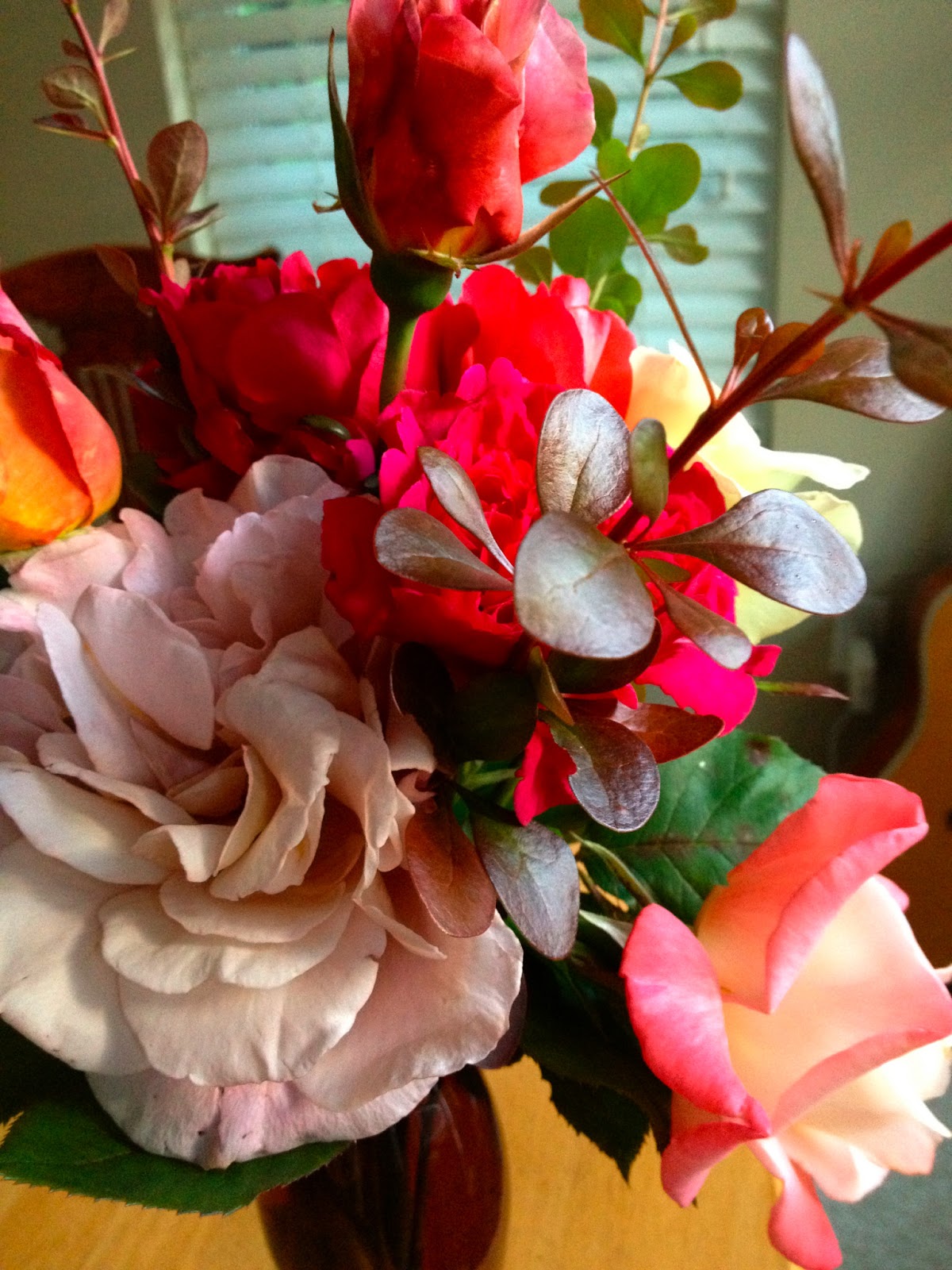
This last bouquet is made up of roses from Dad's garden.  I'm not necessarily a fan of roses given how fussy they are but I may be a convert.  This sweet little bouquet perfumed the whole house for days and I loved how the the gorgeous shades of pink, red, orange, and mauve complimented each other.  I stuck a few branches of barberry bush in there for height and contrast.  This is one scary plant with a sharp thorn hidden behind each rosy leaf.


In the end, I can't really say that I "arranged" these flowers.  When the flowers you have are all so beautiful and fresh, it takes very little skill to put them together in a pleasing way.  But I'll still take that gold star.


This last photo is just a bonus picture of a flower called "kalmia."  I'd never seen this sort of flower before but found it on campus one day while walking to my office.  The kalmia is a plant related to the rhododendron, and its flowers and leaves can be deadly.  It's sweet clusters spiral upward and remind me of something else that's sweet:


But you've already been warned; the flowers are dangerous so no eating.  (They're also know as "sheepkiller flowers" (!!).

Is there such a thing as flower fever?  Because I think I've got it bad.